Insulation in Menlo Park, CA
Spray foam insulation in Menlo Park tackles the two problems this city’s housing stock shares: 1940s–1970s ranch homes built with little or no wall insulation, and Bay-adjacent humidity that degrades whatever fiberglass does exist. Most Menlo Park jobs involve retrofitting older homes to meet California Title 24 energy compliance during gut renovations and ADU additions. Call Sierra Insulation Pleasanton at (925) 574-6007 for a free estimate on any insulation job in Menlo Park.
Why Menlo Park Homes Are Different
Menlo Park’s housing stock is dominated by 1940s–1970s ranch and post-war tract homes, concentrated in neighborhoods like the Willows and Belle Haven. These houses were built when the mild Peninsula climate made insulation seem optional. Most original walls have empty stud bays or, at best, a thin layer of fiberglass that has settled decades ago. Attics typically hold R-11 to R-19 when current code wants R-38 or better.
What changed is the renovation cycle. Tech-wealth buyers are gut-renovating these mid-century homes at a rate we don’t see in neighboring cities, and virtually every permit now triggers mandatory California Title 24 energy compliance. That means blown-in wall insulation, attic retrofits, and crawl space work are the dominant jobs here. The marine layer adds another wrinkle: persistent coastal humidity, not temperature swing, is the real comfort adversary. Wall and attic work in Menlo Park starts with understanding moisture, not just R-value.
The most distinctive failure mode we see is in Belle Haven, east of US-101. Low-lying and close to the Bay, this area accumulates moisture in unencapsulated crawl spaces year-round. Fiberglass batts in mid-century floor assemblies wick that moisture, sag, and eventually rot. Crawl space encapsulation is effectively a prerequisite job there before any insulation upgrade can be warranted.
Our Main Menlo Park Services
Two jobs dominate our Menlo Park schedule: attic insulation retrofits on renovation-era homes, and crawl space encapsulation in moisture-heavy neighborhoods like Belle Haven. Here’s what each looks like in Menlo Park specifically.
Attic Insulation in Menlo Park
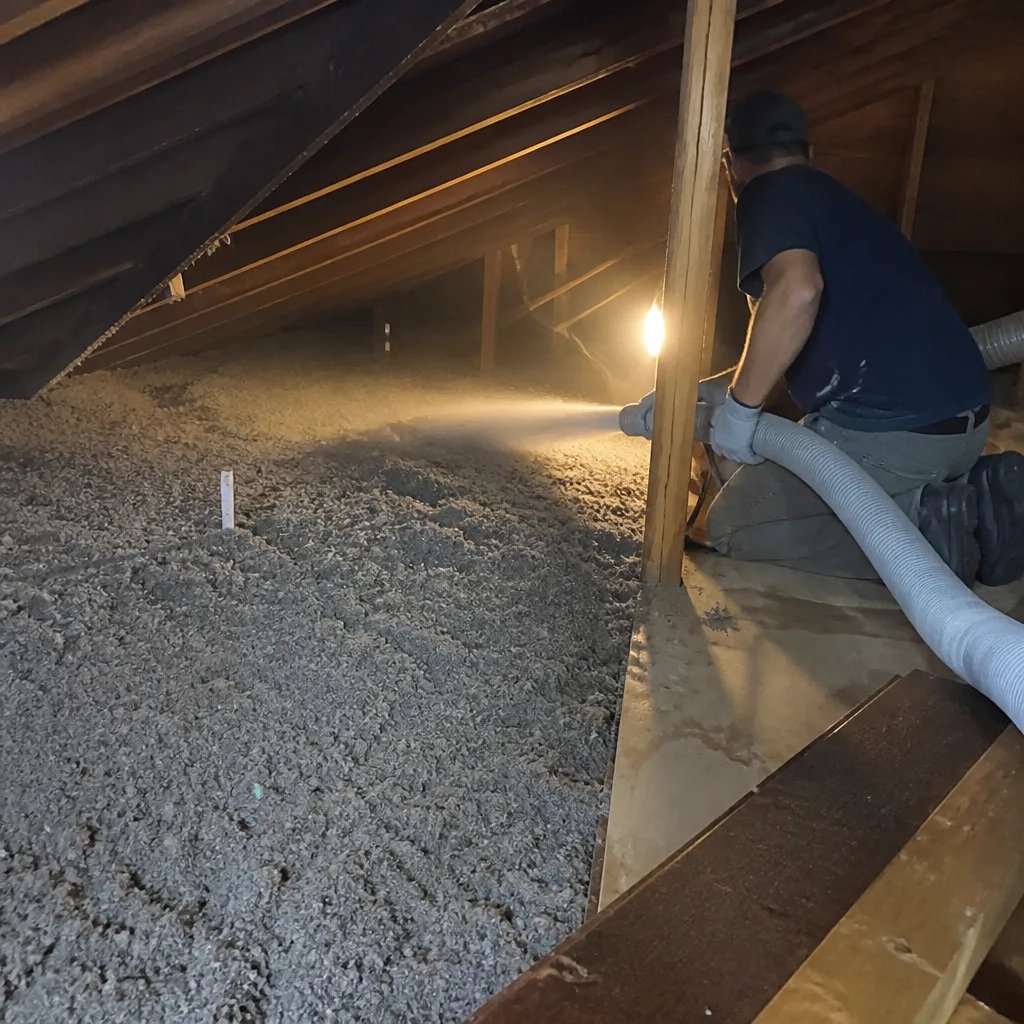
Most Menlo Park attics from the 1940s–1970s hold blown-in fiberglass that has settled to half its original depth, or batt insulation chewed thin by rodents. We remove what’s failing, air seal the attic floor, and install new insulation cut to the home’s actual ceiling depth and Title 24 requirement. In the Willows and other flat-roof-over-vault ranch sections, we often work around recessed can lights and older electrical that needs clearance. See our Attic Insulation in Menlo Park page for the full scope and local pricing.
Crawl Space Encapsulation & Vapor Barrier in Menlo Park
Belle Haven and other low-lying Menlo Park neighborhoods east of US-101 hold moisture in the crawl space year-round. We install vapor barriers, seal foundation vents where appropriate, and insulate rim joists to stop Bay moisture from wicking into floor assemblies. If fiberglass batts under the floor are already saturated and sagging, they get removed and replaced after the encapsulation is complete. Read the Crawl Space Encapsulation & Vapor Barrier in Menlo Park page for the step-by-step and local pricing.
What happens when you call
- 1
A real person answersNo phone trees — you reach a local pro.
- 2
You get an upfront price rangeHonest numbers before anyone is dispatched.
- 3
A background-checked tech heads outLicensed & insured, dispatched right away.
- 4
You approve before work beginsNothing starts until you say go.
Spray Foam Insulation in Menlo Park
Spray foam insulation in Menlo Park solves what fiberglass never could in these 1940s–1970s homes: air sealing and insulation in one pass. The marine layer that rolls through Menlo Park pushes humid air into attics and crawl spaces, and open stud bays in older ranch walls leak conditioned air straight outside. Spray Foam Insulation expands into every gap, stopping air movement in a way batts simply cannot. We install open-cell and closed-cell foams from Icynene and Demilec, matched to the specific cavity and moisture conditions of each Menlo Park home.
Open-Cell Spray Foam
Signs you need it
Rooms that never match the thermostat setting, or an attic that feels warm and stuffy in summer even with existing insulation. If you can hear street noise through your walls, that’s another sign the stud bays are not sealed.
What it costs in Menlo Park
Open-cell spray foam in Menlo Park attics and walls typically runs $1.00–$2.50 per board foot installed, with most whole-attic jobs landing between $2,500 and $6,000.
How we do it
We prep the cavity, mask off the work area, and spray a continuous layer of open-cell foam that expands to fill the space. It air-seals while it insulates, which is why it outperforms batts in Menlo Park’s humid marine air.
Closed-Cell Spray Foam
Signs you need it
Crawl spaces that stay damp, rim joists with visible moisture staining, or any area where you need structural strength plus insulation. Closed-cell foam is the only insulation we install that also acts as a vapor barrier.
What it costs in Menlo Park
Closed-cell spray foam in Menlo Park runs $1.50–$4.00 per board foot, with typical rim joist and crawl space jobs falling between $1,800 and $5,500 depending on square footage.
How we do it
We spray a dense, rigid layer that bonds to the substrate, blocks moisture, and adds racking strength to the framing. In low-lying Menlo Park neighborhoods like Belle Haven, this is often the difference between a crawl space that stays dry and one that keeps wicking moisture.
Rim Joist Spray Foam
Signs you need it
Cold floors in rooms above the crawl space, or a musty smell that comes up through the floorboards. Rim joists are the most common air leak in Menlo Park’s raised-foundation ranch homes.
What it costs in Menlo Park
Rim joist spray foam in Menlo Park usually runs $800–$2,500 for a typical ranch home perimeter, depending on joist depth and access.
How we do it
We clean each joist bay, mask surrounding surfaces, and spray a continuous bead of closed-cell foam along the entire rim. This seals the joint between foundation and framing, which is where most crawl space air exchange happens.
What Spray Foam Insulation Costs in Menlo Park
| Item | Typical range in Menlo Park |
|---|---|
| Open-cell attic spray foam | $2,500 – $6,000 |
| Closed-cell rim joist spray foam | $800 – $2,500 |
| Closed-cell crawl space spray foam | $1,800 – $5,500 |
| Per board foot (open-cell) | $1.00 – $2.50 |
| Per board foot (closed-cell) | $1.50 – $4.00 |
Is spray foam worth the cost in Menlo Park’s climate?
For most Menlo Park homes, yes. The marine layer pushes humid air into attics and crawl spaces nearly year-round, and spray foam is the only insulation that air-seals while it insulates. Homes in Belle Haven and near the Bay see the fastest payback because moisture is a constant enemy there.
How long does spray foam installation take in Menlo Park?
Most attic or crawl space spray foam jobs in Menlo Park are completed in one to two days, including prep and cleanup. Rim joist work alone usually takes half a day. Call (925) 574-6007 for a specific timeline on your home.
Blown-In Insulation in Menlo Park
Blown-in insulation in Menlo Park is the fastest, least disruptive way to upgrade the empty or settled walls and attics in 1940s–1970s ranch homes. These houses were built when Peninsula temperatures felt mild enough that insulation was treated as optional, but today’s Title 24 compliance and comfort standards say otherwise. Blown-In Insulation fills the cavities that batts never touched, using fiberglass or cellulose blown through small access holes. In Menlo Park’s renovation-heavy neighborhoods like the Willows, we do more dense-pack wall retrofits than nearly any other job type.
Blown-In Cellulose
Signs you need it
Rooms that feel drafty in winter or warm in summer despite the thermostat running. If your attic insulation looks like a thin, settled layer of dust, cellulose blown to depth is the answer.
What it costs in Menlo Park
Blown-in cellulose in Menlo Park attics typically runs $1,200–$3,500 depending on square footage and target R-value, with wall retrofits landing between $2,500 and $6,000.
How we do it
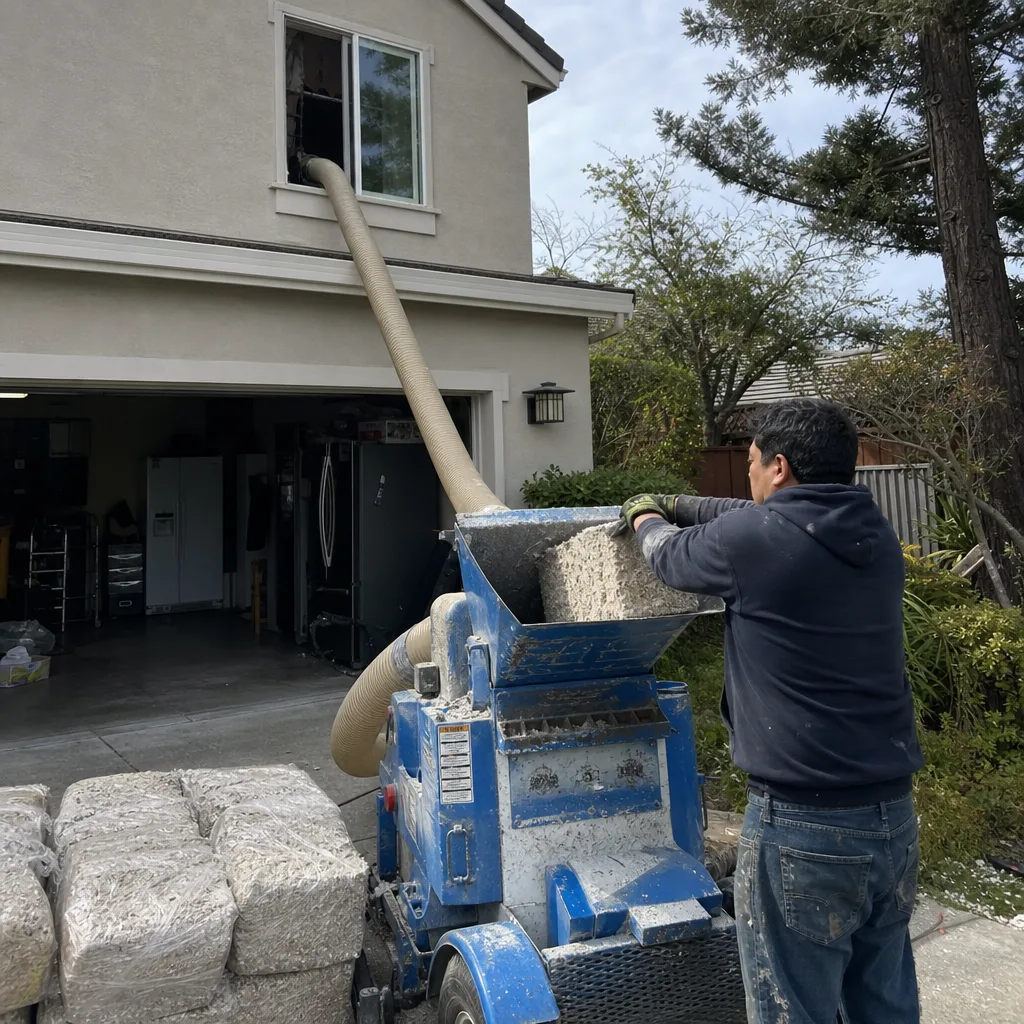
We remove any failing material, air seal the attic floor, and blow cellulose to the depth required for your target R-value. Walls get dense-packed through small drill holes that we patch after.
Dense-Pack Wall Insulation
Signs you need it
Exterior walls that are cold to the touch in winter, or rooms that never hold temperature. Most Menlo Park ranch homes built before 1980 have empty stud bays, and dense-pack is the least invasive way to fix that.
What it costs in Menlo Park
Dense-pack wall insulation in Menlo Park runs $2,500–$6,000 for a typical ranch home, depending on wall area and access from inside or out.
How we do it
We drill small access holes, blow fiberglass or cellulose into each stud bay under pressure, and verify fill density. The holes get patched and painted to match, so you’d never know we were there.
What Blown-In Insulation Costs in Menlo Park
| Item | Typical range in Menlo Park |
|---|---|
| Blown-in attic insulation (cellulose or fiberglass) | $1,200 – $3,500 |
| Dense-pack wall insulation | $2,500 – $6,000 |
| Blown-in top-up over existing insulation | $800 – $2,000 |
| Full removal and re-insulation | $3,000 – $7,000 |
Does blown-in insulation settle over time in Menlo Park homes?
Cellulose settles slightly in the first year and then stabilizes; we account for that by blowing deeper than the target R-value. Fiberglass settles less. Either way, we inspect the attic every time we’re on site, and the numbers above assume proper depth from the start.
Can you blow insulation into walls without removing drywall in Menlo Park?
Yes, and it’s our most common wall job in Menlo Park. We drill small holes through exterior or interior surfaces, blow the cavity full, and patch. It beats opening walls on a 1950s ranch. Call (925) 574-6007 for a wall-by-wall estimate.
Radiant Barrier Installation in Menlo Park
Radiant barrier installation in Menlo Park targets the single biggest heat load on these mid-century ranch homes: the attic roof deck. The Peninsula sun beats down for hours even when the air temperature stays mild, and uninsulated roof decks turn attics into ovens that radiate heat down into living space. Radiant Barrier Installation reflects that heat back out instead of letting the attic absorb it. Homes in Menlo Park with dark composition shingle roofs and little or no roof deck insulation see the biggest comfort difference.
Attic Radiant Barrier
Signs you need it
An attic that’s unbearable to enter on a sunny day, or upstairs rooms that never cool down even with the AC running. If your attic has old or minimal insulation, a radiant barrier cuts the heat coming in from above.
What it costs in Menlo Park
Attic radiant barrier in Menlo Park typically runs $1,500–$4,000 for a standard ranch attic, depending on roof pitch and access.
How we do it
We staple a reflective foil layer to the underside of the roof deck or rafters, leaving an air gap that lets the foil actually work. It reflects radiant heat instead of absorbing it, which lowers attic temperatures in Menlo Park’s sunny summer afternoons.
Radiant Barrier Roof Deck
Signs you need it
Rooms directly under the roofline that run 5–10 degrees warmer than the rest of the house, or an attic fan that never seems to keep up with the heat.
What it costs in Menlo Park
Roof deck radiant barrier in Menlo Park falls between $2,000 and $5,500 when combined with roof deck insulation, depending on square footage and roof complexity.
How we do it
We install the foil directly against the roof deck sheathing, then layer insulation where appropriate. The foil blocks radiant heat before it enters the attic; the insulation handles what still gets through.
What Radiant Barrier Installation Costs in Menlo Park
| Item | Typical range in Menlo Park |
|---|---|
| Attic radiant barrier (foil on rafters) | $1,500 – $4,000 |
| Roof deck radiant barrier + insulation | $2,000 – $5,500 |
| Radiant barrier with new attic insulation | $3,000 – $7,000 |
| Radiant barrier + ventilation upgrade | $2,500 – $5,000 |
Does a radiant barrier actually work in Menlo Park’s climate?
Yes, with an honest caveat. Menlo Park’s heat problem is solar gain on warm afternoons, and a radiant barrier reduces that specific load. It works best paired with attic air sealing and proper insulation; on its own it’s not a substitute for thermal insulation.
Can a radiant barrier be added to an existing Menlo Park attic without removing insulation?
Usually yes. We staple the foil to the rafters or roof deck above the existing insulation, leaving the air gap the foil needs. In low-clearance attics we work from planks and take care not to compress what’s already there. Call (925) 574-6007 and we’ll assess your attic layout.
Insulation Removal & Replacement in Menlo Park
Insulation removal and replacement in Menlo Park is a job we do for two reasons: moisture damage and rodent contamination. The Bay-adjacent humidity in low-lying parts of Menlo Park wicks into fiberglass batts through unencapsulated crawl spaces, and older attics in the Willows and Belle Haven get colonized by rodents that shred insulation and leave waste behind. Insulation Removal & Replacement starts with extracting everything that’s failing, sanitizing the space, and installing new material that matches the home’s actual conditions.
Attic Insulation Removal
Signs you need it
Insulation that’s compressed, stained, or smells musty. If you can see rodent droppings mixed into the fiberglass, or if the insulation is decades old and barely reaching R-11, removal is the right call before adding anything new.
What it costs in Menlo Park
Attic insulation removal in Menlo Park typically runs $1,500–$4,000 depending on attic size and access, before new insulation is installed.
How we do it
We vacuum out the old material with a commercial extraction machine, bag it, and haul it away. Then we inspect the attic floor for air leaks and rodent damage before any new insulation goes in.
Contaminated Insulation Removal
Signs you need it
Rodent droppings, urine staining, or nesting material mixed into the insulation. This is common in Menlo Park attics where roof or soffit gaps have let rats and mice in over the years.
What it costs in Menlo Park
Contaminated insulation removal in Menlo Park runs $2,000–$5,000, including sanitizing and decontamination of the attic space before re-insulation.
How we do it
We remove all contaminated material, HEPA-vacuum the space, apply an antimicrobial treatment, and seal the entry points that let rodents in. Only then do we install fresh insulation.
What Insulation Removal & Replacement Costs in Menlo Park
| Item | Typical range in Menlo Park |
|---|---|
| Attic insulation removal only | $1,500 – $4,000 |
| Contaminated insulation removal + sanitizing | $2,000 – $5,000 |
| Full removal + new blown-in insulation | $3,000 – $7,000 |
| Vermiculite or old insulation removal | $2,500 – $6,000 |
How do I know if my Menlo Park attic insulation needs to be removed or just topped up?
If the existing insulation is dry, uncontaminated, and just settled, a blown-in top-up is usually enough. If it’s stained, rodent-contaminated, or saturated from Bay moisture, removal is the only honest fix. We’ll tell you which one you need during the estimate.
Is moldy insulation dangerous in Menlo Park’s humid crawl spaces?
Moldy or moisture-saturated insulation holds moisture against the framing, promotes rot, and degrades indoor air quality. In low-lying areas like Belle Haven, it’s common enough that we check every floor assembly during a crawl space job before recommending anything. Call (925) 574-6007 to schedule an inspection.
Attic Air Sealing in Menlo Park
Attic air sealing in Menlo Park is the step most homes skip, and it’s the step that determines whether new insulation actually works. Warm air rises out of the living space through gaps around top plates, can lights, and the attic hatch, pulling cold Bay air in through the crawl space. Attic Air Sealing closes those gaps before insulation goes in. On Menlo Park’s 1940s–1970s ranches, we routinely find top plate gaps and unsealed can lights that leak more air than an open window.
Attic Floor Air Sealing
Signs you need it
Rooms that feel drafty even with the windows closed, or an attic where you can see daylight around plumbing vents and wiring penetrations. If your energy bill spikes in winter, air leaks are usually the cause.
What it costs in Menlo Park
Attic floor air sealing in Menlo Park typically runs $800–$2,500 depending on attic size, number of penetrations, and the condition of the existing insulation.
How we do it
We clear insulation away from each penetration, seal it with foam or caulk, and re-cover. Every top plate, wire hole, and vent pipe gets treated before new insulation goes in.
Can Light & Duct Boot Sealing
Signs you need it
Recessed can lights that feel warm, or ducts that rattle when the system runs. Old metal can housings leak air straight into the attic, and unsealed duct boots pull attic air into your rooms.
What it costs in Menlo Park
Can light and duct boot sealing in Menlo Park runs $600–$1,800 depending on how many fixtures and boots need work.
How we do it
We seal around each fixture with approved covers or foam, and seal every duct boot to the drywall with mastic. This stops conditioned air from escaping into the attic and attic air from leaking into your living space.
What Attic Air Sealing Costs in Menlo Park
| Item | Typical range in Menlo Park |
|---|---|
| Attic floor air sealing | $800 – $2,500 |
| Top plate and penetration sealing | $700 – $2,000 |
| Can light and duct boot sealing | $600 – $1,800 |
| Attic hatch sealing & weatherstripping | $150 – $500 |
Why do I need air sealing before insulation in Menlo Park?
Insulation slows heat transfer, but it doesn’t stop air movement. In Menlo Park’s marine climate, humid air gets pulled through gaps in the attic floor and condenses against cold surfaces. Sealing first means the insulation stays dry and actually performs at its rated R-value.
How much of a difference does attic air sealing really make in Menlo Park?
It’s not unusual to cut air leakage by 30–50% in a 1950s ranch home. The effect shows up in lower heating bills, fewer drafts, and a house that holds temperature better. Call (925) 574-6007 and we’ll run a blower door test to show you the before-and-after.
Wall Insulation in Menlo Park
Wall insulation in Menlo Park is the single most common retrofit on the city’s post-war ranch and tract homes. Most were built before energy codes required any wall insulation, so the stud bays sit empty while conditioned air escapes through the drywall into the siding. Wall Insulation fixes that without opening up every wall. On Menlo Park’s 1940s–1970s homes, interior radiant heat loss through uninsulated stud bays matters more to comfort than the outside air temperature does.
Injection Foam Wall Insulation
Signs you need it
Exterior walls that feel cold in winter or radiate heat in summer, or rooms that never match the thermostat. If your home was built before 1980 in Menlo Park, the odds are high the walls are empty.
What it costs in Menlo Park
Injection foam wall insulation in Menlo Park runs $3,000–$8,000 for a typical ranch home, depending on wall area and number of stories.
How we do it
We drill small holes into each stud bay from inside or outside, inject foam that expands to fill the cavity, and patch. The foam air-seals as it insulates, which is a big advantage in Menlo Park’s humid marine air.
Drill & Fill Wall Insulation
Signs you need it
Rooms on the north side of the house that stay cold, or walls that feel hollow when you knock on them. Drill and fill works for both empty cavities and partially insulated walls.
What it costs in Menlo Park
Drill and fill wall insulation in Menlo Park runs $2,500–$6,000 depending on wall area, siding type, and access.
How we do it
We drill access holes in the siding or drywall, blow dense-pack fiberglass or cellulose into each cavity, and verify fill. Holes get patched and painted to match the surrounding surface.
What Wall Insulation Costs in Menlo Park
| Item | Typical range in Menlo Park |
|---|---|
| Injection foam wall insulation | $3,000 – $8,000 |
| Drill and fill wall insulation | $2,500 – $6,000 |
| Exterior wall insulation (new construction / addition) | $4,000 – $10,000 |
| Interior wall soundproofing | $1,500 – $4,000 |
Does wall insulation really matter in Menlo Park’s mild climate?
Yes, and here’s why: the Bay-adjacent marine layer keeps temperatures moderate, but it also keeps the air humid. Empty wall cavities let that humid air move through your home, and the interior surfaces feel cold because the wall itself is uninsulated. Insulation stops the radiant loss and the air movement.
Can you insulate walls without removing the siding or drywall in Menlo Park?
Yes. We drill small holes and insulate from one side or the other, then patch. It’s the standard approach for Menlo Park’s occupied ranch homes where tearing out drywall isn’t practical. Call (925) 574-6007 for a wall-by-wall breakdown.
Attic Cleaning & Rodent Proofing in Menlo Park
Attic cleaning and rodent proofing in Menlo Park gets called in for a problem we see constantly in the Willows and Belle Haven: rats and mice entering through roof and soffit gaps in 1940s–1970s homes, then shredding insulation and contaminating the space. Attic Cleaning & Rodent Proofing removes what they left behind and seals the entry points so they can’t come back. This is not a job you want to put off; rodent damage gets worse every month and pushes up the eventual insulation replacement cost.
Attic Cleanout
Signs you need it
Scratching sounds overhead, droppings in the attic, or insulation that looks matted and pressed down where animals have been nesting. If your attic smells musty or you can see shredded paper or fiberglass, it’s time for a cleanout.
What it costs in Menlo Park
Attic cleanout in Menlo Park typically runs $800–$2,500 depending on attic size, amount of debris, and whether the insulation needs removal.
How we do it
We remove all debris and damaged insulation, HEPA-vacuum the space, and inspect the entire attic for entry points. The result is a clean surface ready for repair and re-insulation.
Rodent Proofing & Exclusion
Signs you need it
Recurring rodent activity despite traps or poison. Menlo Park’s older homes have roof intersections, soffit gaps, and chimney chases that rats can squeeze through; sealing those entry points is the only permanent fix.
What it costs in Menlo Park
Rodent proofing and exclusion in Menlo Park runs $1,500–$4,000 depending on how many entry points exist and what materials are needed to seal them.
How we do it
We identify every current and potential entry point, seal them with wire mesh, foam, and hardware cloth, and install barriers where needed. Then we sanitize the attic and verify the space is fully sealed before re-insulating.
What Attic Cleaning & Rodent Proofing Costs in Menlo Park
| Item | Typical range in Menlo Park |
|---|---|
| Attic cleanout (debris and droppings) | $800 – $2,500 |
| Sanitizing and decontamination | $1,000 – $3,000 |
| Rodent proofing and exclusion | $1,500 – $4,000 |
| Attic restoration (cleaning + re-insulation) | $3,000 – $7,000 |
Do I need to remove all the insulation if rodents were in my Menlo Park attic?
Usually yes, if the contamination is widespread. Rodent urine and droppings create a health hazard, and the insulation has lost its thermal performance anyway. We remove it, sanitize, seal entry points, and install fresh material.
Can rodent proofing actually keep rats out of my Menlo Park home?
Yes, when done correctly. The key is sealing every entry point, not just the obvious ones. We inspect the roofline, soffits, and any penetration through the attic floor, then close them with materials rodents can’t chew through. Call (925) 574-6007 for an attic inspection.
Home Energy Audit in Menlo Park
A home energy audit in Menlo Park gives you the diagnostic picture before any insulation gets priced or installed. We find the problem before we sell you the fix. Home Energy Audit is a standalone service, not a sales tactic; we measure air leakage with a blower door, scan for thermal gaps with an infrared camera, and map out exactly where your home is losing energy. For Menlo Park’s pre-1980 ranches, this usually reveals that the biggest losses are air leaks around top plates and uninsulated stud bays, not the attic alone.
Blower Door Test
Signs you need it
Drafty rooms, high heating bills, or a house that never holds temperature. A blower door test quantifies how leaky your home is, which tells us whether air sealing is worth doing before insulation.
What it costs in Menlo Park
A blower door test in Menlo Park typically runs $250–$600 depending on home size and whether it’s part of a full audit.
How we do it
We mount a calibrated fan in an exterior door frame, depressurize the house, and measure exactly how many cubic feet per minute leak in. The results give us a leakage number we can compare before and after air sealing.
Thermal Imaging Inspection
Signs you need it
Colder or warmer spots on walls and ceilings, or areas where you suspect missing insulation. The infrared camera shows temperature differences that reveal exactly where insulation is missing or failing.
What it costs in Menlo Park
Thermal imaging inspection in Menlo Park runs $200–$500 as part of a full energy audit, depending on home size and level of detail.
How we do it
We scan every ceiling, wall, and floor with an infrared camera while the blower door is running. Missing insulation and air leaks show up as temperature anomalies on the scan, which we then document for you.
What a Home Energy Audit Costs in Menlo Park
| Item | Typical range in Menlo Park |
|---|---|
| Blower door test | $250 – $600 |
| Thermal imaging inspection | $200 – $500 |
| Full home energy audit | $500 – $1,500 |
| Duct leakage test | $200 – $500 |
Is a home energy audit worth it in Menlo Park before an insulation job?
Yes, especially on pre-1980 homes. The audit tells us where the actual losses are, so you don’t spend money on insulation that won’t solve the problem. It’s the difference between guessing and measuring.
What does a Menlo Park home energy audit actually include?
A full audit includes a blower door test, thermal imaging, insulation inspection, and a duct leakage test. You get a written report with the findings and a list of what will actually move the needle. Call (925) 574-6007 to schedule one.
Brands We Service in Menlo Park
We install insulation from Johns Manville, Knauf, Rockwool, and CertainTeed in Menlo Park homes, along with spray foam lines from Icynene and Demilec. Material choice depends on the home’s actual conditions, not what’s on the shelf. See our brands for the full list and when we recommend each one.
Pricing for Insulation in Menlo Park, CA
| Service | Typical range in Menlo Park |
|---|---|
| Spray foam insulation (attic or crawl space) | $2,500 – $6,000 |
| Blown-in attic insulation | $1,200 – $3,500 |
| Dense-pack wall insulation | $2,500 – $6,000 |
| Radiant barrier installation | $1,500 – $4,000 |
| Insulation removal & replacement | $3,000 – $7,000 |
| Attic air sealing | $800 – $2,500 |
| Attic cleaning & rodent proofing | $800 – $4,000 |
| Home energy audit | $500 – $1,500 |
Prices in Menlo Park move up when attics are tight, crawl spaces are wet, or the home needs rodent remediation before insulation can go in. We quote upfront and don’t add surprise line items: the number we give you is the number you pay.
Serving Menlo Park, CA — Our Local Coverage Area
We’re based in the Menlo Park area and know this community well. Use the map below to see our service coverage — if you’re nearby, we can almost certainly help.
Neighborhoods We Serve in Menlo Park
We work throughout Menlo Park, from the Willows and Belle Haven to Sharon Heights, Allied Arts, and the neighborhoods around downtown. We’re in the area regularly and can schedule most estimates within a few days.
- The Willows
- Belle Haven
- Sharon Heights
- Allied Arts
FAQs About Insulation in Menlo Park, CA
How fast can you schedule an insulation job in Menlo Park?
We typically book Menlo Park jobs within one to two weeks, and can move faster for attic air quality or pest issues. Most homes take a day or two depending on scope. We confirm your start date after seeing the attic or walls in person.
Does insulation work in Menlo Park require a permit?
Straightforward attic and wall insulation usually does not need its own permit, but any renovation or addition in Menlo Park does trigger mandatory California Title 24 energy compliance, and that can include the insulation scope. We will let you know if your project falls into that category before we start.
How does the written estimate work?
We measure the attic, crawl space, or wall cavities on-site and hand you a written price before any work is scheduled. That estimate covers materials and labor for the exact scope we discussed, so the number does not change once the crew arrives.
Do you cover neighborhoods near Menlo Park?
Yes, we serve the surrounding communities as well as Menlo Park itself, so tell us your address and we will confirm we can get to you.
What do you do with the insulation you remove?
Old batts, contaminated material, and anything rodent-damaged gets bagged and hauled away for proper disposal. Given the coastal humidity here, we also check for moisture damage before installing anything new, and will flag it separately if we find any.
Frequently Asked Questions
What happens when you call
- 1A real person answersNo phone trees — talk to a local insulation pro.
- 2You get an upfront price rangeHonest numbers before anyone is dispatched. No surprises.
- 3A background-checked tech heads outLicensed & insured, typically within 1-hour.
- 4You approve before work beginsNothing starts until you say go.
What Menlo Park Customers Say
"Plastic laid from the front door to the attic hatch and they vacuumed the hallway afterward."
— Grace Kim"Spray foam in the rim joists in the basement. The cold floors above them are gone."
— Veronica Ramirez"Work is good and the house is noticeably more comfortable. There was insulation debris left in the hall closet under the attic access that I had to clean up."
— Ryan Sullivan