
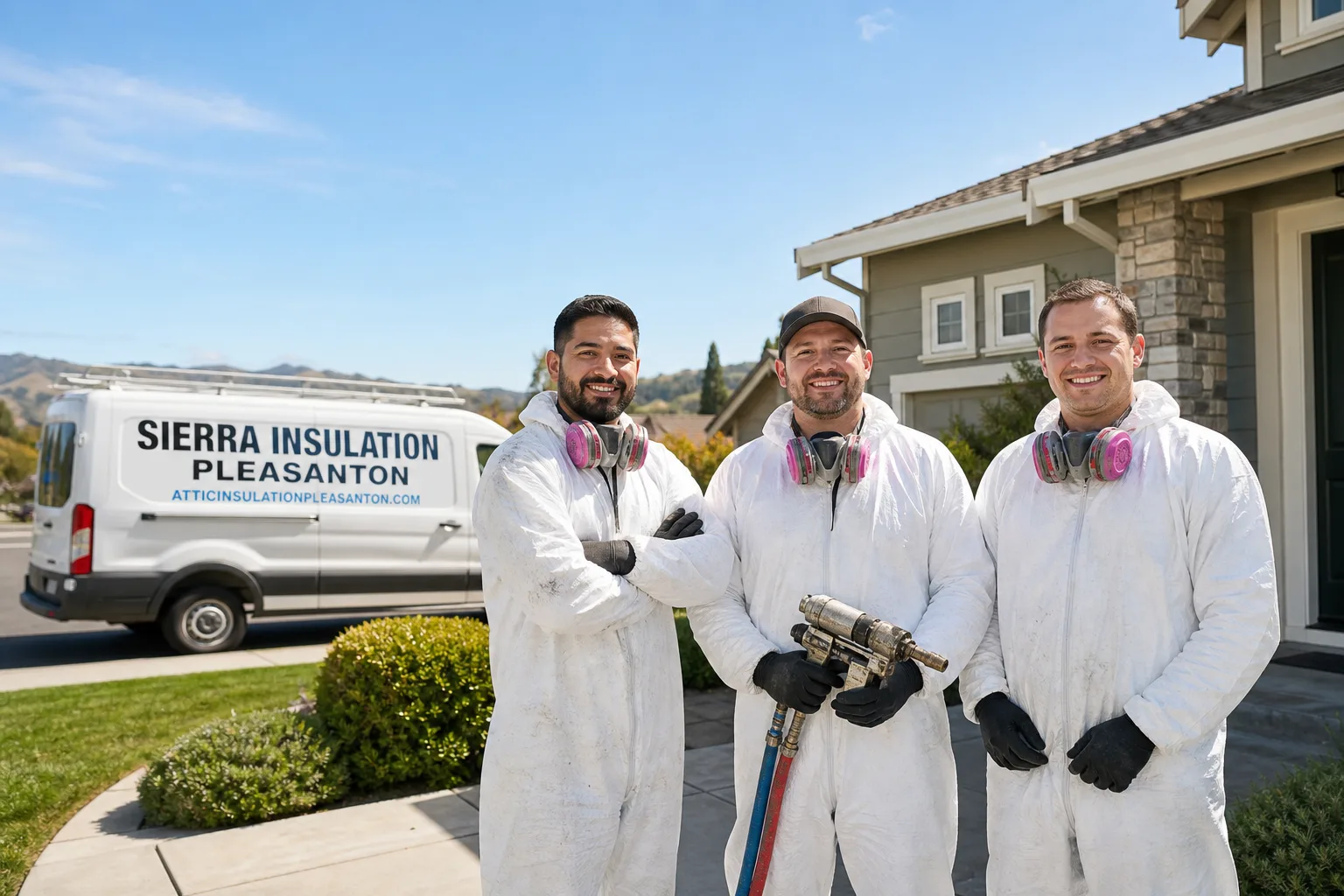
Trusted Spray Foam Insulation for Pleasanton Homeowners
Spray foam insulation in Pleasanton costs roughly $2,200 to $6,800 for a typical attic or wall application, with closed-cell foam running higher than open-cell due to material density and R-value per inch. Most Pleasanton homes we assess see a 30 to 50 percent reduction in air leakage after foam is applied, which is why this is the single most requested insulation upgrade we install. If your upstairs rooms bake in July while the downstairs stays cold, or your HVAC cycles constantly without holding temperature, spray foam is usually the fix, not another thermostat adjustment.
We’re Sierra Insulation, and the person who quotes your Pleasanton job is the same person who installs it. Nate Caldwell, our owner, leads every spray foam application personally. No subcontractors, no crew you’ve never met, no handoff between sales and install. Call (925) 574-6007 and you’ll talk to Nate directly. He’ll tell you whether spray foam is the right material for your house or whether a different insulation approach makes more sense. That’s the diagnostic-first approach we’ve built the company on, and it’s why Pleasanton homeowners call us when they want the problem found before the fix is sold.
What Our Spray Foam Insulation Service Includes
Spray foam isn’t one product. It’s a family of materials with different densities, R-values, and moisture characteristics, and the wrong selection can cause real problems in a Pleasanton home. We stock Icynene and Demilec foam lines, which are two of the most recognized names in open-cell and closed-cell foam chemistry. Here’s exactly what we install and when each product makes sense.
Open-Cell Spray Foam
Open-cell foam is a low-density material that expands to roughly 100 times its liquid volume, filling stud bays, rafter cavities, and irregular framing with an air-sealing blanket of foam. It delivers about R-3.6 per inch, which makes it a strong choice for interior walls and attic applications in Pleasanton where sound dampening and air sealing matter more than maximum R-value per inch. The material stays slightly pliable after curing, so it moves with the house through seasonal temperature swings without cracking or pulling away from framing. We typically recommend open-cell Icynene for attic roof decks and interior partition walls where budget matters and the cavity has enough depth to reach the target R-value.
Closed-Cell Spray Foam
Closed-cell foam cures hard, adds structural rigidity to wall assemblies, and delivers roughly R-6.5 to R-7 per inch, making it the highest R-value insulation available per inch of thickness. In Pleasanton’s climate, we often specify closed-cell Demilec for crawl space rim joists, garage ceilings adjacent to living space, and exterior walls where homeowners want to maximize insulation without adding wall depth. The material acts as a vapor barrier at two inches of thickness, which means it stops moisture migration as well as heat transfer, something fiberglass cannot claim. For homes in East Pleasanton where lot sizes limit room additions, closed-cell on exterior walls is a common way to boost thermal performance without reframing.
Rim Joist Spray Foam
The rim joist, the band of framing where your floor meets your foundation wall, is one of the leakiest parts of any Pleasanton home, and it’s almost never insulated in houses built before 2000. We apply a two-inch closed-cell foam band across the entire rim joist perimeter, sealing the gap where outside air pushes into the basement or crawl space. This single application routinely cuts floor-level drafts and keeps crawl space humidity from migrating up into your living space. It’s a small job that delivers outsized comfort results, especially in neighborhoods like Birdland and Val Vista where older ranch homes sit over vented crawl spaces.
Garage Ceiling Spray Foam
If you have a finished room above the garage, that ceiling cavity needs a thermal break, and blown-in fiberglass alone won’t stop air movement through the joist bays. We spray closed-cell foam across the garage ceiling to create an air and thermal seal between the unconditioned garage and the conditioned room above. Pleasanton homes with bonus rooms, home offices, or master suites over the garage are prime candidates, because the floor above an unconditioned garage typically runs five to ten degrees different from the rest of the house. This is one of the most requested sub-services we handle for homes in the Ruby Hill area.
Spray Foam Roof Deck
Applying spray foam directly to the underside of the roof deck turns the attic into a conditioned space, which keeps ductwork inside the thermal envelope instead of cooking in a 140-degree attic during Pleasanton summers. We typically use open-cell Icynene for this application on roof decks with standard framing, applying it from the soffit to the ridge and air-sealing the whole assembly in one pass. The payoff is immediate: your air handler and ducts stop fighting attic heat, and rooms stop stratifying between floors. For Pleasanton homes with vaulted ceilings or knee-wall attics, roof deck foam is often the only practical way to achieve a sealed attic without a full roof tear-off.
What happens when you call
- 1
A real person answersNo phone trees — you reach a local pro.
- 2
You get an upfront price rangeHonest numbers before anyone is dispatched.
- 3
A background-checked tech heads outLicensed & insured, dispatched right away.
- 4
You approve before work beginsNothing starts until you say go.
Brands We Service for Spray Foam Insulation
Spray foam chemistry matters. We run Icynene and Demilec materials because their open-cell and closed-cell foam lines have the longest track records in residential applications, and because both companies maintain consistent formulations we can rely on from job to job. Icynene’s open-cell foam expands predictably even in cooler weather, which matters for Pleasanton crawl space work we perform from October through March when temperatures dip into the forties overnight. Demilec’s closed-cell product cures hard and bonds to framing aggressively, and we’ve applied it on everything from rim joists to exterior wall cavities in Pleasanton, Newark, and the surrounding East Bay.
We also carry Owens Corning and CertainTeed fiberglass lines, plus Rockwool mineral wool and GreenFiber blown-in cellulose, because spray foam isn’t always the correct prescription. A Pleasanton homeowner with a vented attic, no ductwork in the roof, and a reasonable budget may be better served by air sealing plus blown-in insulation. Our material selection is driven by the home’s actual conditions, not by what we happen to have in the truck. If you have concerns about the open-cell versus closed-cell decision, we’ll walk you through the R-value targets, the moisture profile, and the noise characteristics of each before we quote a single dollar.
Signs You Need Spray Foam Insulation Right Now
- Rooms above the garage never hold temperature. The cavity between your garage ceiling and the room above it is almost always uninsulated or under-insulated, and it leaks air around every joist bay. Spray foam closes that envelope permanently, and it’s a one-day fix for a room you’ve probably been avoiding since you moved in.
- Your upstairs is 8 to 10 degrees warmer than your downstairs in summer. Heat loads the attic and pushes down through the ceiling plane, and in Pleasanton’s triple-digit July days that delta becomes unbearable. Foaming the attic floor or roof deck puts a thermal stop between that heat and your living space, which equalizes floor-to-floor temperatures by design, not by turning the AC down.
- You feel drafts at the baseboards in winter. Air enters through the rim joist where the floor framing sits on the foundation, and it travels up wall cavities and out at floor edges. This is a rim joist spray foam issue, and it’s the single most cost-effective air sealing upgrade we perform in Pleasanton’s older homes.
- Your energy bills climb every year while your usage stays the same. PG&E rates in Pleasanton have risen sharply, and a house with a leaky thermal envelope costs more to condition every single time rates tick up. Air sealing with spray foam is the only insulation product that simultaneously stops air movement and adds R-value, which is why it outperforms fiberglass in older, drafty homes.
- You can smell the crawl space from the living room. Floor cavities over damp, vented crawl spaces allow soil gases and moisture to migrate up through the subfloor. Closed-cell foam on the rim joist or under the floor stops that stack effect and keeps crawl space air where it belongs: in the crawl space, not your house.
Our Spray Foam Insulation Process — Step by Step
Every spray foam installation in Pleasanton follows the same disciplined sequence, and Nate leads each step personally. This is the difference between a crew spraying product and an owner verifying the work.
- 1
Energy audit or attic assessment. We start by finding the problem, not by selling foam. A blower door test, which depressurizes the house so we can pinpoint where air enters, shows us exactly which cavities are leaking. For most Pleasanton homes we’ll also inspect the attic, crawl space, and rim joist with an infrared camera. You’ll see the readings before we recommend anything.
- 2
Material and depth specification. Based on the audit, we’ll specify open-cell or closed-cell foam, the target R-value, and the exact areas to be treated. We’ll also flag any prep work: rodent remediation in the attic, old insulation removal, or vent baffles that need to be in place before foam is applied. You get a written scope, not a verbal promise.
- 3
Site preparation. We mask and protect all surfaces that aren’t being sprayed, seal off the work area from the living space, and set up ventilation as required by the foam manufacturer’s installation standards. For attic jobs, we’ll clear the work path and protect stored items if any remain. Foam application is precise work, and prep is half the job.
- 4
Spray foam application. Nate runs the spray gun on every job. He applies the foam in passes to reach the specified depth, checking thickness as he goes with a depth gauge. The chemistry, temperature, and humidity are monitored throughout, because foam that’s applied too thick in one pass can cure improperly. Pleasanton’s dry summer air and cool winter mornings each require slightly different application technique, and that experience is exactly what you’re paying for.
- 5
Post-install inspection and verification. After the foam cures, we perform a second blower door test to measure the before-and-after air leakage. You’ll see the number. Most Pleasanton homes drop 30 to 50 percent in air changes per hour, which translates directly into HVAC runtime reduction. We also do a thermal camera sweep to confirm there are no voids or thin spots, and we leave you with photos of the completed work in every cavity.
How Much Does Spray Foam Insulation Cost in Pleasanton?
What moves the price is access. Attics with steep pitches, low clearance, or existing insulation that needs removal cost more. Crawl spaces with standing water or rodent damage require remediation before foam can go in. And closed-cell foam costs more per board foot because the material is denser and delivers roughly double the R-value per inch of open-cell. The best way to avoid overpaying is to know exactly what you’re paying for: a written scope that specifies foam type, target R-value, square footage of application, and prep work included. Our estimates are free, and they include a blower door number if the job warrants an audit. Call (925) 574-6007 and Nate will walk your house first, then talk numbers. That’s the only order that makes sense.
Spray Foam Insulation Near Pleasanton — Our Service Area
We run spray foam installations throughout the Tri-Valley and the southern East Bay, from Pleasanton out to Sunol, and across the bay to Newark, Union City, and Milpitas. For Pleasanton homeowners we’re typically on site within 24 to 48 hours for an estimate, and emergency rim joist and garage ceiling work can often be scheduled same-week. If you’re in a neighboring city, the same owner-installed standard applies, whether you need Spray Foam Insulation in Newark or Spray Foam Insulation in Sunol. We cover the entire home thermal envelope, from attic to crawl space, and we bring the same diagnostic-first approach to every job, not just the big ones.
Serving Pleasanton, CA — Our Local Coverage Area
We’re based in the Pleasanton area and know this community well. Use the map below to see our service coverage — if you’re nearby, we can almost certainly help.
Frequently Asked Questions — Spray Foam Insulation in Pleasanton
Spray foam insulation is a two-part liquid that expands on contact into a foam that air-seals and insulates in one application. It’s the only residential insulation that stops air movement while adding R-value, which makes it the most effective product for leaky homes needing Spray Foam Insulation in Pleasanton. We install open-cell Icynene for sound dampening and attic applications, and closed-cell Demilec where moisture control and maximum R-value per inch are the priority.
A rim joist application in a Pleasanton home is usually a half-day job, and a garage ceiling takes about the same. A full attic roof deck application typically runs one to two days, including prep and cleanup. The foam itself cures within minutes, so the house is safe to occupy the same day as the installation.
Most Pleasanton spray foam jobs we quote fall between $1,400 for a small rim joist application and $13,000 for a full closed-cell roof deck on a large attic, and you can read more about how much Spray Foam Insulation costs in our pricing guide. Open-cell applications run about 40 percent less than closed-cell on the same area. Call (925) 574-6007 for a free estimate with a written scope, so you know exactly what’s included before any work begins.
Yes, we install both Icynene open-cell and Demilec closed-cell foam systems, and we’ve been applying both lines across Pleasanton, Spray Foam Insulation — Sunol, and the surrounding East Bay. These are two of the most recognized foam brands in residential insulation, and we chose them for consistency of formulation and published performance data. If you have a question about either system, we’ll walk you through the differences before you commit.
For most Pleasanton and Spray Foam Insulation in Union City jobs we can have an estimate done in 24 to 48 hours and installation scheduled within the week, depending on the scope. Rim joist and garage ceiling work is often completed within a few days of the estimate. For emergency situations like a dropped ceiling or exposed cavities before a storm, call (925) 574-6007 and Nate will, if it can be done safely, prioritize your job.
Icynene and Demilec both publish long-term performance warranty documentation, and we’ll walk you through the specifics for your application in Pleasanton before you sign anything. The materials are designed to last the life of the structure, and closed-cell foam in particular does not settle or degrade the way loose-fill products can. Call us for the exact warranty terms that apply to your project.
For most Pleasanton spray foam jobs, the main preparation is clearing access to the work area, which for attics and crawl spaces means removing stored items, and for garage ceilings means moving vehicles and anything below the spray area. We handle the rest: masking, ventilation, and post-job clean-up are all part of the scope. If you have pets, we’ll ask that you keep them out of the work zone during application, since the material cures quickly but the process generates overspray that’s messy before it sets.
Schedule Your Spray Foam Insulation Service in Pleasanton Today
If your Pleasanton home has drafty rooms, uneven temperatures, or energy bills that keep climbing, we’ll find the cause before we recommend a cure. Call Nate at (925) 574-6007 for a free, no-obligation estimate that includes a real diagnostic pass, not a square-footage guess. We’re owner-installed on every job, we carry the right materials for the right application, and we stand behind the work from first air leak test to final thermal camera verification. The estimate costs you nothing. The fix might cost less than another year of PG&E increases.
Written by Nate Caldwell, Owner at Sierra Insulation Pleasanton, serving Pleasanton and the surrounding East Bay.